Pakistan Salary Tax Calculator 2026-27: Slabs, Formula
Quick answer: If your annual taxable salary is up to Rs. 600,000 (Rs. 50,000 a month), you pay nothing. Above that, Pakistan uses a slab system — you only pay the higher rate on the portion of your taxable income that falls in that slab, not your whole salary. Below, you’ll find the full 2026-27 slabs, a simple formula, and worked examples so you can check your own number in under a minute.
Salary Tax Calculator
Pakistan, FY 2026-27
Enter your gross salary to see your exact FBR income tax, take-home pay, and where you sit on the slab ladder — calculated instantly, with a full bracket-by-bracket breakdown.
Based on the salaried-individual slabs under the Income Tax Ordinance 2001 (Finance Act / Finance Bill rates). Salaried means salary income exceeds 75% of total taxable income — business owners and freelancers should use the Business or Freelancer calculator instead. This tool is for guidance only and isn’t a substitute for advice from a registered tax consultant; rates for FY 2026-27 reflect Finance Bill 2026 and may be subject to final National Assembly approval.
If you’ve ever opened your payslip and wondered “why did they deduct this much tax?” — you’re not alone. Salary tax in Pakistan looks confusing at first, but once you see how the slabs work, it’s honestly just basic math. Let’s break it down the easy way.
What Changed in Budget 2026-27
Good news first: this year’s budget actually gave the salaried class a break. Here’s what’s new, in plain words:
These changes were introduced through the Finance Bill 2026, presented on June 12, 2026, and passed by the National Assembly on June 26, 2026. After presidential assent, the Finance Act 2026 was formally enacted on June 27, 2026, with the new rates effective from July 1, 2026 (Tax Year 2027) onward.
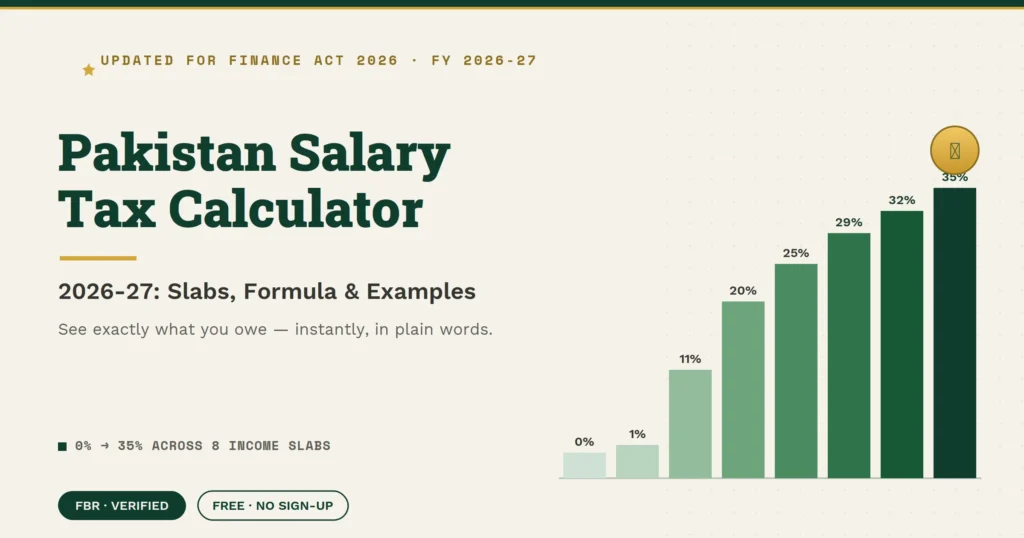
The Official Salary Tax Slabs for 2026-27
Here’s the full table. Find your annual taxable salary range, and that’s your slab.
Salaried Individual Tax Slabs — FY 2026-27
Hover any row to see how it lines up against the others. Rates apply to annual taxable salary income under the Finance Bill 2026 rates.
Rates reflect the Finance Bill 2026 slabs for salaried individuals (salary income exceeding 75% of total taxable income) and may be subject to final National Assembly approval. Not a substitute for advice from a registered tax consultant.
Tip: Don’t panic when you see “35%” and assume that’s your whole tax bill. It only applies to the slice of income sitting in that top bracket — everything below it is still taxed at the lower rates.
Note: These salaried slabs generally apply where salary makes up more than 75% of your total taxable income. If you also have significant business, freelance, or rental income alongside your salary, different rules may apply — it’s worth checking with a tax advisor in that case.
Important: “Taxable Salary” Isn’t Always Your Full Salary
These slabs apply to your annual taxable salary, not necessarily your full gross pay. Your actual tax may be lower if your payroll includes an exempt portion of medical allowance, an approved Zakat deduction, a pension fund contribution credit, or other exempt allowances. On the flip side, taxable bonuses and arrears get added on top for the period they’re paid. So think of the numbers below as a very close estimate — your payslip may differ slightly depending on your specific salary structure.
How to Calculate It Yourself (3 Simple Steps)
You don’t need an accountant for this. Just follow these steps:
Step 1: Find your annual taxable salary.
Multiply your monthly taxable salary by 12. So Rs. 150,000/month = Rs. 1,800,000/year.
Step 2: Find your slab.
Look at the table above and see which range your annual taxable salary falls into.
Step 3: Apply the formula for that slab.
Take the fixed amount for your slab, then add the percentage on whatever is above the slab’s starting point.
That’s it. No complicated software needed — just a calculator app on your phone.
Real Examples (So You Can Just Match Your Salary)
These examples assume your full monthly pay is taxable — meaning no exempt allowances or deductions are applied. Your own number could be a bit lower once you factor in things like Zakat or an exempt medical allowance.
Example 1: Monthly taxable salary of Rs. 100,000
Example 2: Monthly taxable salary of Rs. 150,000
Example 3: Monthly taxable salary of Rs. 250,000
Example 4: Monthly taxable salary of Rs. 500,000
Quick Reference: Monthly Salary Tax Table
What Tax Will You Pay? — Common Salary Levels
A quick look-up for common monthly salaries. Hover a row to see it highlighted against the rest.
| Monthly taxable salary | Annual taxable salary | Estimated monthly tax |
|---|---|---|
| 50,000 | 600,000 | 0 Tax-free |
| 100,000 | 1,200,000 | 500 |
| 150,000 | 1,800,000 | 6,000 |
| 250,000 | 3,000,000 | 23,000 |
| 500,000 | 6,000,000 | 92,000 |
Figures are estimates under the FY 2026-27 salaried-individual slabs and may differ slightly from your exact tax if you have allowances, benefits-in-kind, or other adjustments. Use the full calculator above for a precise number.
Handy Tips to Lower Your Tax (Legally)

Frequently Asked Questions
Is my salary tax-free if I earn under Rs. 50,000 a month?
Yes. Anything up to Rs. 600,000 a year (Rs. 50,000/month) is completely tax-free under the FY 2026-27 slabs.
Does the tax slab depend on whether I’m a filer or non-filer?
No, salary tax slabs apply the same way regardless of your filer status. But non-filers pay higher withholding tax on other things, like bank transactions and property deals — so it still pays to file your return.
What happened to the 9% surcharge on high earners?
It’s gone. The Finance Act 2026 removed the 9% surcharge that used to apply to salaried individuals earning over Rs. 10 million a year.
Does this apply to freelancers and business owners too?
No, these specific slabs are for salaried individuals. Freelancers and business owners are taxed under different rules. For example, IT and IT-enabled service exporters may qualify for a reduced tax rate, but only if they meet the specific registration and documentation conditions set by FBR and PSEB.
Can bonuses push me into a higher tax bracket permanently?
No. A bonus is added to your income only for the month/year it’s paid, so your tax may spike that period, but your regular monthly slab goes back to normal afterward.
Conclusion
Salary tax in Pakistan looks intimidating on paper, but once you break it into slabs, it’s really just simple math you can do on your phone in a minute. The FY 2026-27 changes bring real relief — lower rates on the middle brackets, a higher entry point for the top rate, and no more surcharge for high earners. So if you were dreading your next payslip, there’s a good chance you’ll actually keep a bit more of your salary this year.
The one thing worth remembering: always calculate based on your taxable salary, not your full gross pay, since allowances and deductions can shift the number. When in doubt, a quick check with your HR team or a tax advisor will confirm exactly where you stand.
Note:
These slabs reflect the Finance Act 2026 as passed by Parliament. Tax rules can be clarified or amended by FBR notifications, so for anything filing-related, it’s always smart to double-check with a tax consultant or the official FBR website.
Sources:
PwC Tax Summaries — Pakistan Individual Deductions and Taxes on Personal Income (Zakat, medical allowance, and salary-income rules): taxsummaries.pwc.com/pakistan/individual
Federal Board of Revenue (FBR) — Budget 2026-27, Finance Act 2026 and Salient Features: fbr.gov.pk/Budget2026-27/default.html
KPMG Pakistan — “A Brief on Finance Act 2026” (National Assembly approval and enactment dates): kpmg.com/pk/en/insights/2026/07/a-brief-on-finance-act-2026.